|
|
VANCOUVER SUN: DEC 14 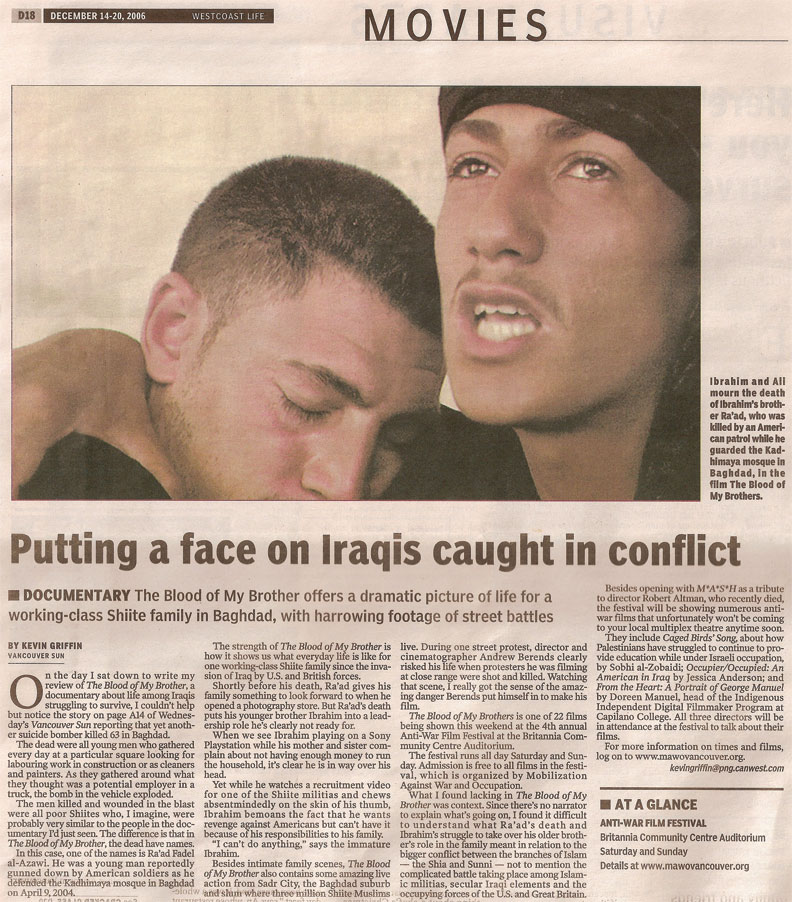 click for larger version Putting a face on Iraqis caught in conflict The Blood of My Brother offers a dramatic picture of life for a working-class Shiite family in Baghdad, with harrowing footage of street battles On the day I sat down to write my review of The Blood of My Brother, a documentary about life among Iraqis struggling to survive, I couldn't help but notice the story on page A14 of Wednesday's Vancouver Sun reporting that yet another suicide bomber killed 63 in Baghdad. The dead were all young men who gathered every day at a particular square looking for labouring work in construction or as cleaners and painters. As they gathered around what they thought was a potential employer in a truck, the bomb in the vehicle exploded. The men killed and wounded in the blast were all poor Shiites who, I imagine, were probably very similar to the people in the documentary I'd just seen. The difference is that in The Blood of My Brother, the dead have names. In this case, one of the names is Ra'ad Fadel ll-Azawi. He was a young man reportedly gunned down by American soldiers as he defended the Kadhimaya mosque in Baghdad on April 9,2004. The strength of The Blood of My Brother is how it shows us what everyday life is like for one working-class Shiite family since the invasion of Iraq by U.S. and British forces. Shortly before his death Ra'ad givrs his family something to look forward to when he opened a photography store. But Ra'ad's death puts his younger brother Ibrahim into a leadership role he's clearly not ready for. When we see Ibrahim playing on a Sony Playstation while his mother and sister complain about not having enough money to run the household, it's clear he is in way over his head . Yet while he watches a recruitment video for one of the Shiite militias and chews absentmindedly on the skin of his thumb, Ibrahim bemoans the fact that he wants revenge against Americans but can't have it because of his responsibilities to his family. "I can't do anything," says the immature Ibrahim. Besides intimate family scenes, The Blood of My Brother also contains some amazing live action from Sadr City, the Baghdad suburb and slum where three million Shiite Muslims live. During one street protest, director and cinematographer Andrew Berends clearly risked his life when protesters he was filming at close range were shot and killed. Watching that scene, I really got the sense of the amazing danger Berends put himself in to make his film. The Blood of My Brother is one of 22 films being shown this weekend at the 4th annual Anti-War Film Festival at the Britannia Community Centre Auditorium. The festival runs all day Saturday and Sunlabouring day.Admission is free to all films in the festival, which is organized by Mobilization Against War and Occupation. What I found lacking in The Blood of My Brother was context. Since there's no narrator to explain what's going on, I found it difficult to understand what Ra'ad's death and Ibrahim's struggle to take over his older brother's role in the family meant in relation to the bigger conflict between the branches of Islam - the Shia and Sunni - not to mention the complicated battle taking place among Islamic militias, secular Iraqi elements and the occupying,forces of the U.S. and Great Britain. Besides opening with M*A*S*H as a tribute to director Robert Altman, who recently died, the festival will be showing numerous antiwar films that unfortunately won't be coming to your local multiplex theatre anytime soon. They include Caged Birds' Song, about how Palestinians have struggled to continue to provide education while under Israeli occupation, by Sobhi al-Zobaidi; Occupier/Occupied: An American in Iraq by Jessica Anderson; and From the Heart: A Portrait of George Manuel by Doreen Manuel, head of the Indigenous Independent Digital Filmmaker Program at Capilano College. All three directors will be in attendance at the festival to talk about their films. For more information on times and films, log on to www.mawovancouver.org. AT A GLANCE ANTI-WAR FILM FESTIVAL Britannia Community Centre Auditorium Saturday and Sunday Details at www.mawovancouver.org |
24 HOURS: DEC 14 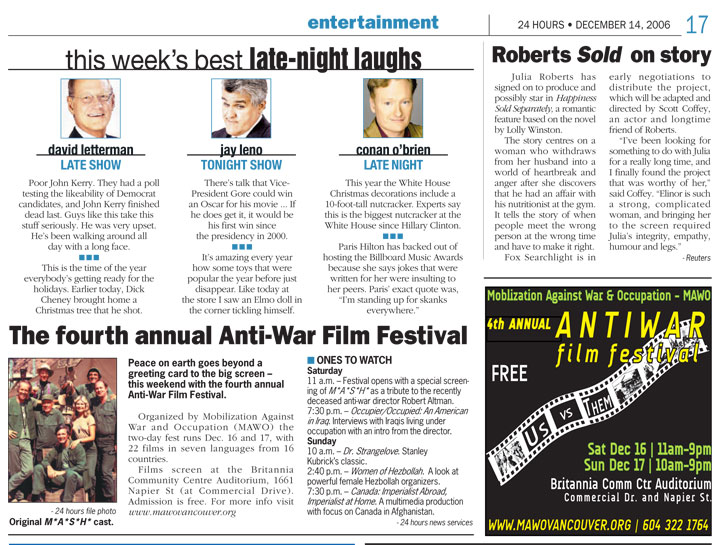 click for larger version 4th annual Anti-War Film Festival Peace on earth goes beyond a greeting card to the big screen this weekend with the fourth annual Anti-War Film Festival. Organized by Mobilization Against War and Occupation (MAWO) the two-day fest runs Dec. 16 and 17, with 22 films in seven languages from 16 countries. Films screen at the Britannia Community Centre Auditorium, 1661 Napier St (at Commerical Drive). Admission is free. For more info visit www.mawovancouver.org
Saturday 7:30p.m. - Occupier/Occupied: An American in Iraq Interviews with Iraqis living under occupation with an intro from the director. Sunday 10 a.m. - Dr. Strangelove. Stanley Kubrick's classic. 2:40 p.m. – Women of Hezbollah. A look at powerful female Hezbollah organizers. 7:30 p.m. – Canada: Imperialist Abroad, Imperialist at Home. A multimedia production with focus on Canada in Afghanistan. |
GEORGIA STRAIGHT: DEC 14 
click the image to view the original article ANTI-WAR FEST HITS CANADA AT HOME The press release for the Mobilization Against War and Occupation’s fourth annual Anti-War Film Festival sums up war’s greatest irony: its staying power. “In a world that is marked all over by the scars of war and occupation, how could Vancouver’s Anti-War Film Festival do anything but grow?” notes the December 5 release. “And grow it has.” This weekend (December 16 and 17), more than 22 films in seven different languages from 16 countries will be screened in two days at the Britannia Community Centre. Ten showings are premieres, including Kabul director Malik Shafi’i’s End of the Land, about Afghan refugees after 9/11, and the festival closer, the organization’s own documentary, Canada: Imperialist Abroad, Imperialist at Home. MAWO media spokesperson Ivan Drury admits it is a strange irony that a group espousing the end to war trumpets the growth of a festival of this nature. Wouldn’t it be better if the festival shrunk and disappeared? “That would be the ideal, but that’s not the way it goes, or the way it’s going,” Drury told the Straight. “Maybe it’s the kind of thing that has to become a lot stronger before it becomes a lot smaller.” Drury adds that more than 50 local businesses, community groups, service organizations, and labour and student unions have endorsed the festival. He points out that there is a constant theme of us versus them, or oppressed versus oppressor, throughout. Everything from the 1972 documentary Malcolm X to Dr. Strangelove is on display. “It really depends on what people are looking for,” Drury adds. “The real highlights are the films that challenge the perceptions that are pushed forward by the television media, mainstream media, and the [Canadian] government that is going to war [in Afghanistan.]” Admission is by donation. For more information and a full schedule, visit www.mawovancouver.org > Matthew Burrows |